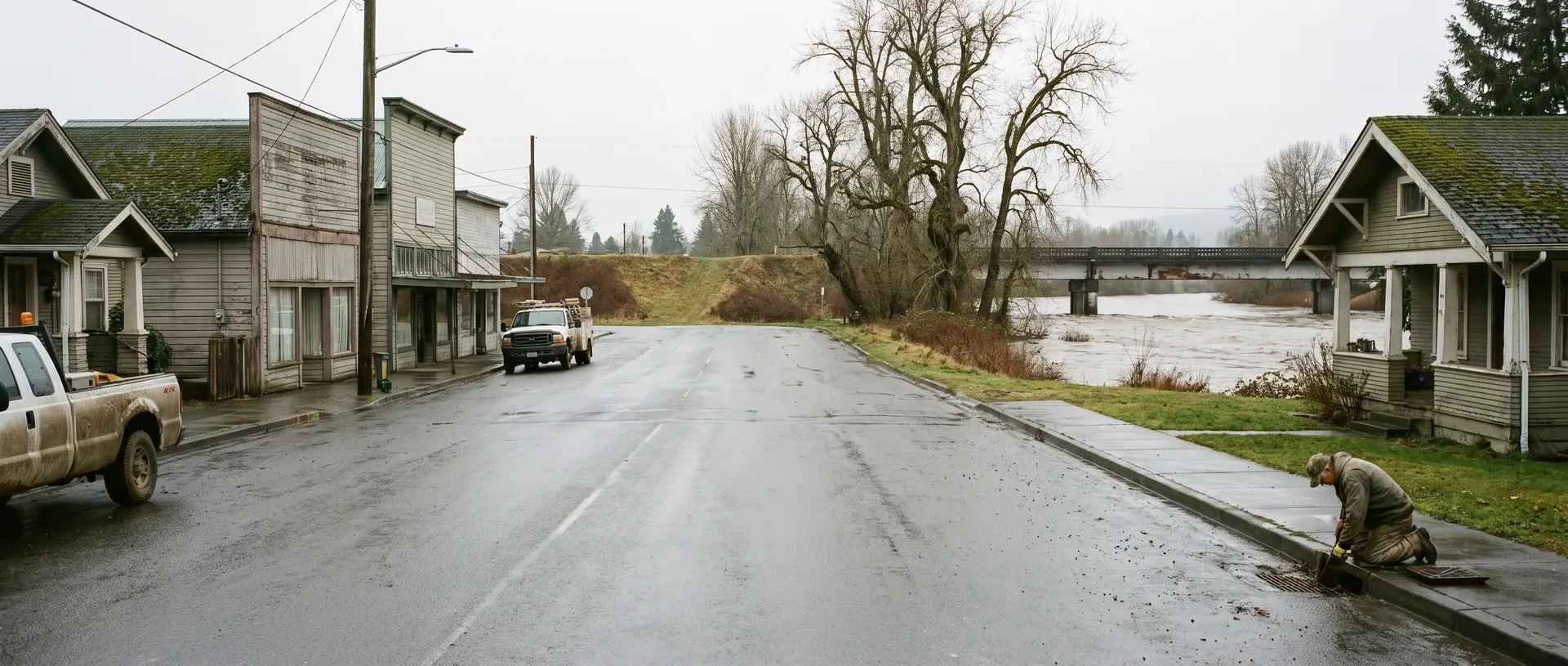
Everson
What we find under Everson and Nooksack properties
Everson sits on the Nooksack, with the town of Nooksack immediately next door, surrounded by farmland. Properties in the two small city cores are on city sewer. Outside them it is acreage and septic, with the long house to tank runs that go with it.
The thing that makes drains here different is the river.
The November 2021 flooding put water through a large number of these properties. When floodwater enters a building it enters the drainage system too, and it does not arrive clean. It carries silt, fine sand and agricultural debris. Water leaves. Silt does not. It settles in the flattest parts of the run and it stays there, and unless somebody has since jetted or cameraed the line, a good deal of it is still sitting where it landed.
The pattern that produces is distinctive. The line was fine before. It is not blocked now. It is simply slower than it used to be, and it blocks more easily than it used to, because a section of it is partly full of sediment that a cable will punch straight through without removing.
That is a jetting job, not a cabling job, and it is worth doing once properly rather than clearing a channel through it every winter.
What we do here
What we do in Everson
Drain cleaning for fixtures in town and on the surrounding acreage.
Hydro jetting, which is the right tool for flushing settled silt out of a run.
Sewer camera inspection to see how much sediment is actually in the line and where.
Main sewer line clearing for city laterals and house to tank runs.
Clogged toilets and fixture drains throughout Everson and Nooksack.
Kitchen and grease line cleaning for houses and small commercial kitchens.
Sewer line repair where flooding or saturated ground has damaged the pipe itself.
Emergency drain service for active backups, ahead of scheduled work.
Local knowledge
Why a flooded line behaves differently
Silt is not a blockage in the usual sense. There is no plug to break through and no object to retrieve. It is a layer of fine material lying along the bottom of the pipe, reducing the working area and taking away the depth of flow that keeps solids moving.
A cable through that does very little. The head cuts a groove along the top of the sediment, water follows it, and the line drains again. Everything that made it slow is still in there.
Water at pressure is different. A jetter lifts fine sediment into suspension and flushes it back to the access point, which is the only way to get it out rather than move it further along. On a line with a known flood history that is the correct first step, and a camera run before and after is what tells you whether it worked.
The second thing worth knowing is that saturated ground moves. Prolonged inundation and the drying that follows can shift a shallow line enough to open a joint that was fine before. So a post flood camera run is not only about sediment. It is also about whether the pipe still has the shape and the grade it had in 2020.
Questions
Everson questions
Can flooding damage a sewer line?
Yes, in two ways. It fills the line with silt and debris that stays after the water goes, and prolonged saturation can move the ground enough to shift joints or change the fall. A camera run after a flood tells you which of those you are dealing with.
My drains have been slower since the flood. Is that connected?
Very likely. That is the standard pattern: not blocked, just slower and quicker to block, because sediment is sitting in the flattest part of the run. Jetting removes it. Cabling mostly moves it.
Do you cover Nooksack as well as Everson?
Yes, both, along with the surrounding farmland and the properties out toward Sumas and Deming.
Do you work on septic drain lines out here?
Yes, on the run from the house to the tank, which is often long on these properties. We do not pump tanks, inspect tanks or work on drain fields.
Tell us the symptoms