Sumas
What we find under Sumas properties
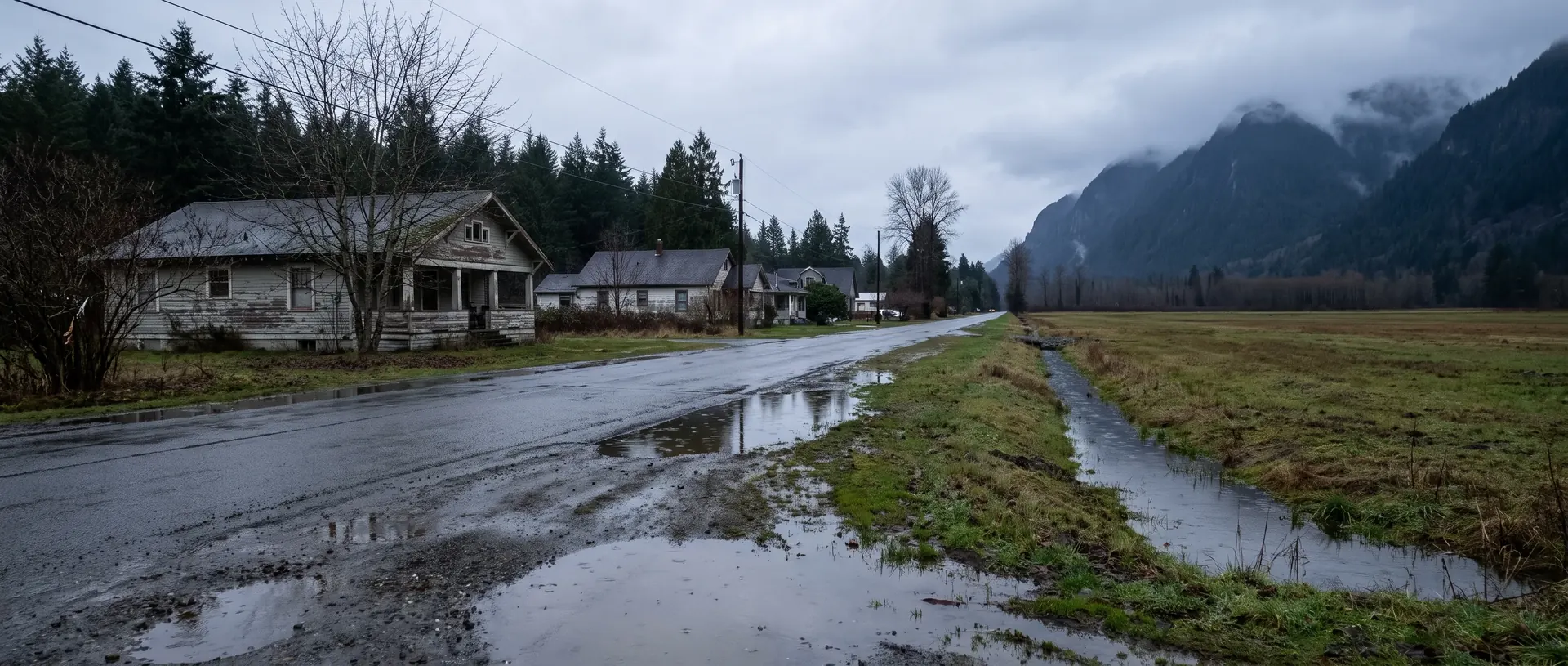
Sumas is a small city on the Canadian border, on some of the flattest and wettest ground in Whatcom County. It has a city sewer system, a compact street grid, and farmland immediately beyond the last houses.
Two conditions dominate the drain work here, and they compound each other.
The first is the water table. It sits high year round and comes up hard in winter, and the lines were generally laid shallow. A sewer pipe surrounded by saturated soil is under constant pressure from the outside. Any joint that has opened, any crack, any failed seal becomes a way in. Groundwater entering the line is not dramatic and it does not announce itself. It just means the pipe is running with water it was never meant to carry.
The second is that this town flooded, badly, in November 2021. Floodwater going through a property goes through its drainage as well, and it leaves silt behind in the flattest part of every run. Some of that sediment is still there.
Put those together and you get the Sumas pattern: a line that is partly full of groundwater, partly full of settled silt, with almost no fall to help it clear itself. It works most of the time. It gives very little warning. And when it goes, it goes properly.
What we do here
What we do in Sumas
Drain cleaning for fixtures throughout the town and the surrounding farmland.
Hydro jetting for settled silt and sludge in flat runs.
Sewer camera inspection to find where groundwater is entering the line.
Main sewer line clearing for city laterals and rural house to tank runs.
Clogged toilets and fixture drains throughout.
Kitchen and grease line cleaning for houses and small commercial kitchens.
Sewer line repair for cracked and open joints taking on groundwater.
Emergency drain service for active backups, ahead of scheduled work.
Local knowledge
Why infiltration is the question we ask first
On most jobs the useful question is what went down the drain. In Sumas the more useful question is often what came in through the side of it.
Infiltration is easy to miss because it does not block anything. The line still drains. What it does is take away headroom. A pipe already running partly full with groundwater has less capacity for the household using it, and no capacity at all for a heavy day. It also keeps solids in suspension and moving too slowly, so they settle out along the run and build up over time.
That is why clearing a Sumas line and calling it done can be misleading. You have removed the consequence and left the cause. A camera run shows the entry point directly, because water coming in through a joint is visible on screen, and a repair at that point is usually short.
It is also why we treat any post flood line here as worth filming even if it seems fine. The combination of saturated ground movement and residual sediment is specific to this town and this decade, and it is not something a homeowner has any way of seeing.
Questions
Sumas questions
Why does my drain back up when it rains heavily?
Usually because groundwater is entering the line through a defect and filling capacity the household needs. Around Sumas the water table alone can do it without any rain at all in midwinter. It is a fixable problem once the entry point is located.
Is my sewer line still affected by the 2021 flood?
It can be. Silt that entered a line then settles in the flat sections and stays unless somebody has jetted it out. Saturated ground can also have shifted joints. A camera run answers both questions in one visit.
Can you dig a repair with the water table this high?
Yes, and it is normal work here, but saturated ground needs dewatering and that is part of the scope from the start rather than a surprise. We will tell you what it involves before we begin.
Do you cover the farms outside town?
Yes, along with the properties out toward Everson, Nooksack and the Kendall and Deming direction. Rural runs are longer and access matters more, so tell us what you know about the cleanout when you call.
Tell us the symptoms