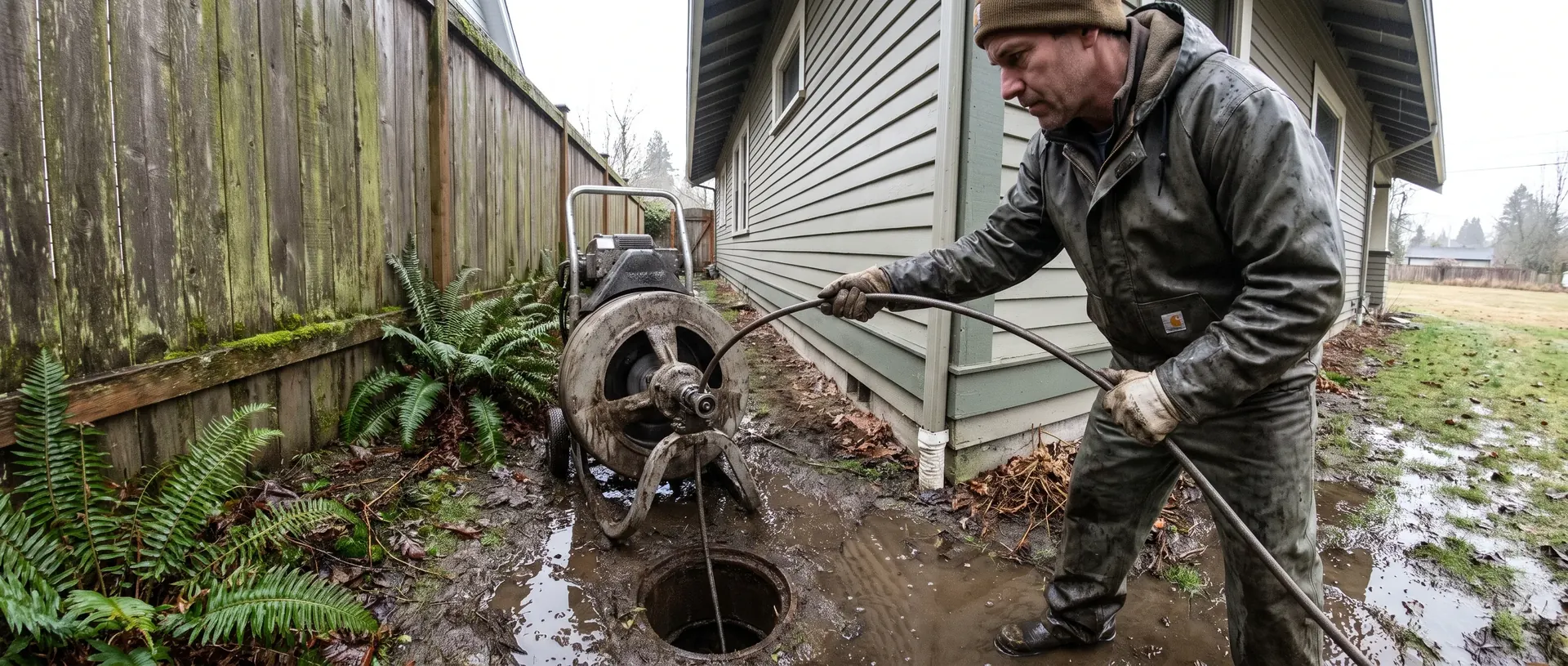
Main Sewer Line Clearing
The one blockage that gets worse while you wait
A single slow fixture is annoying. A restricted main line is a countdown. Every wash cycle, every shower and every flush is going into a pipe that cannot take it, and the water has to go somewhere. That somewhere is the lowest drain in the building: a basement floor drain, a downstairs shower, sometimes a ground floor toilet.
The tell is fixtures reacting to each other. Flush the toilet and the shower gurgles. Empty the washing machine and the basement drain rises. Nothing upstairs is broken. Everything upstairs is fine right up until the moment the shared pipe stops taking water.
Main line work is different from fixture work in every practical way. It is a longer run, larger diameter, usually buried, often reached from outside, and what caused it matters far more. A fixture line clogs because of what went down it. A main line clogs because of what went down it or because the pipe itself has moved, cracked, sagged or filled with roots. Which of those it is decides whether you have had one bad day or the first day of a repair.
What we find
What blocks a main line here
Roots at a joint
Western red cedar and bigleaf maple over an old clay lateral is the classic Whatcom County version. Roots find any joint with moisture at it, then catch every solid that passes. Common under the older Bellingham streets where the trees are older than the pipe.
Structural faults in the pipe
An offset where two sections have shifted, a belly holding standing water, a crack, or Orangeburg conduit that has deformed out of round. These clear and re block on a schedule, and the schedule gets shorter.
Solids and grease over a long flat run
Common on the flat ground out toward Lynden and Ferndale where there is very little fall to help the line clear itself. Add wipes to that and you get a plug rather than a build up.
On the day
What a main line visit includes
Confirming it is the main.
Which fixtures, in what order, and what reacts to what. If it turns out to be one fixture line, we will tell you that and charge you for the smaller job.
Finding the access.
An exterior cleanout is the right way in. A lot of older houses here do not have one, and we tell you what the alternative involves before we start.
Clearing the full run with the correct head.
Out to the transition or the tank, not just far enough to restore flow, and with a cutter sized for what is in there.
A camera run afterwards, as standard.
On a main line this is not an extra. It is the only way to know whether you had a one off or a failing pipe.
Step by step
How we work
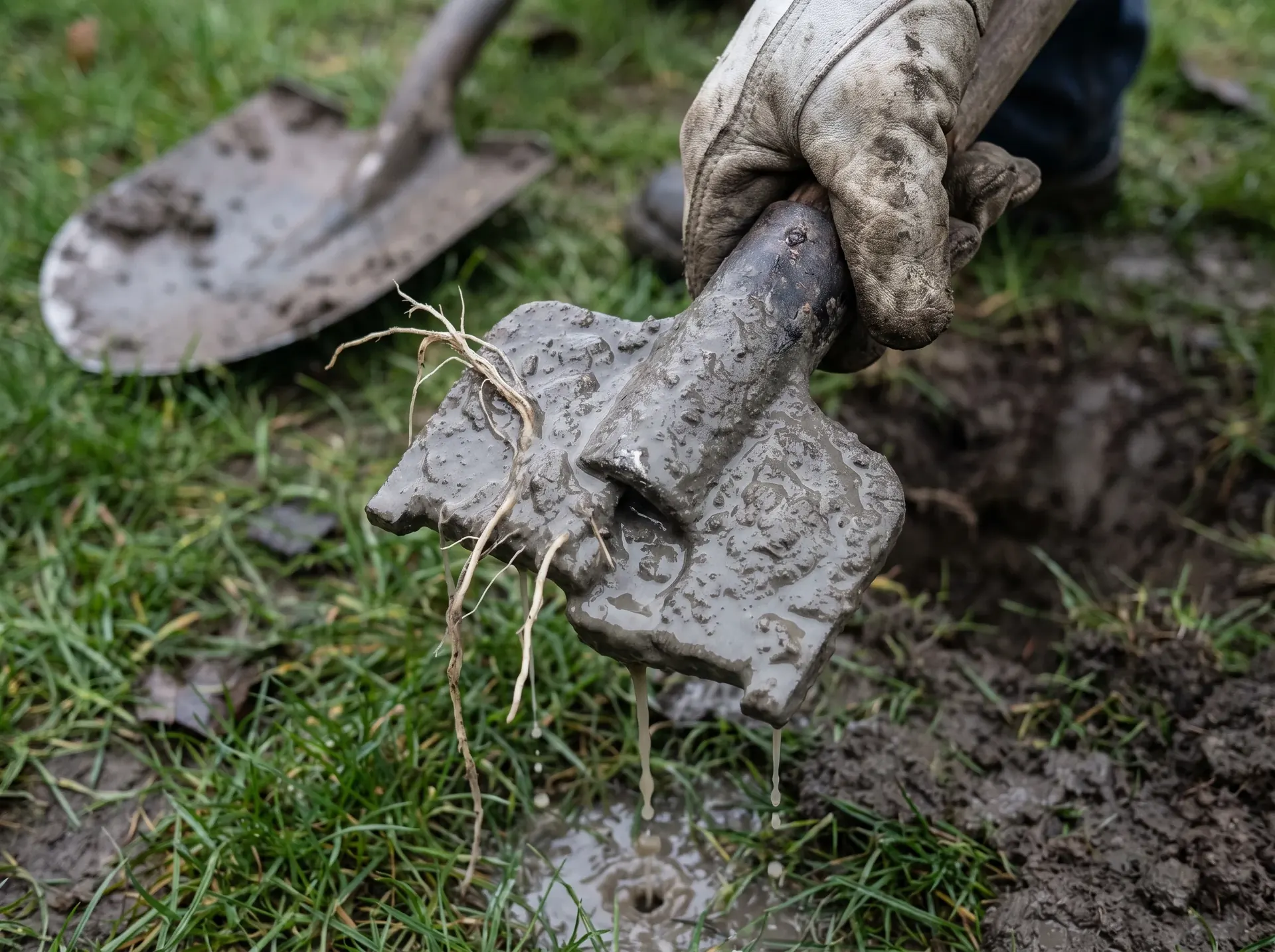
You tell us what is reacting to what.
This one question separates a main line call from a fixture call, and it decides what comes off the truck.
We stop the situation getting worse.
If water is coming up somewhere, the first instruction is to stop using water in the building until we arrive. It is a short conversation and it saves floors.
We get in at the cleanout.
Or tell you honestly what it takes when there is not one.
We clear the whole run.
Cutter head sized to the pipe, worked out to the transition or the tank, cutting on the way back as well as on the way out.
We camera the line.
Recorded, with the distance on screen, and a sonde trace on anything worth locating.
We tell you which of the two situations you are in.
A one off blockage, or a pipe with a defect that will do this again. If it is the second one, you get the footage, the depth and the position, and you can take that anywhere.
Why us
Why call us for this
The camera run is standard, not an upsell
Clearing a main line without looking at it afterwards leaves you with no idea whether it will happen again next month. We would rather you knew.
Active backups come ahead of scheduled work
A main line backing up into a house is not a job that waits for Thursday. It goes ahead of routine visits.
We do not quote a replacement from the driveway
If the footage shows a spot defect, we say spot repair. Digging up a whole lateral is sometimes the right answer and often is not, and the footage is what decides it.
We know where the trees are
Under the pre war Bellingham neighbourhoods the street trees, the clay pipe and the joint spacing are a known combination. It changes what we expect at thirty feet.
Reviews
What our customers say
We have not collected any reviews yet. When we do they will appear here in full, in the customer's own words.
Questions
Main sewer line questions
What are the signs that my main sewer line is clogged?
More than one fixture is affected and they react to each other. Flushing makes a shower gurgle, the washing machine emptying brings water up in a basement drain, or the lowest drain in the house is the one backing up. A single slow sink with everything else normal is a fixture problem, not a main line one.
How much does it cost to clean out a main sewer line?
It turns mainly on access. With an accessible exterior cleanout it is a straightforward job. Without one, the line has to be reached another way and that takes longer, which is worth knowing before anyone arrives. A camera run afterwards is included on main line work rather than added.
Can I clean my sewer line myself?
A short fixture branch, sometimes. A main line, realistically no. Consumer cables are not long or strong enough for a four inch run, they are easy to lose in the pipe, and without a camera you have no way of knowing whether you are working in sound pipe or finishing off something already failing.
How to unclog a main sewer line without a cleanout?
Access has to be made somewhere, usually by pulling a toilet or working from a basement or crawl space connection. It is a bigger job than working from a cleanout and we will say so before starting. On a house with no exterior cleanout it is usually worth installing one at the same time, so the next visit is the easy version.
What chemical can unclog a main sewer line?
None of them, reliably. Chemical cleaners are formulated for a trap, not for a restriction thirty feet down a four inch line, and they sit in the pipe attacking older material while they fail. They also make the water hazardous for whoever has to work in it. Tell us if one has already been used.
How often should home sewer lines be cleaned?
Most never need it on a schedule. The ones that do have a specific reason: roots at a joint, a belly holding water, or a long flat run that silts up. A camera run identifies which group you are in, and if you are not in it we will say so.
Do you handle sewer backups into the house?
Yes, and those calls come ahead of scheduled work. Keep people and pets away from the affected area, stop using water everywhere in the building, and call.
Where we do this work
Anywhere else in Whatcom County, call and ask.
Tell us the symptoms