Sewer Line Repair
Repair the defect, not the whole lateral
There is a version of this trade where every failing sewer line becomes a full replacement quote, because a full replacement is a bigger invoice and it is very hard for a homeowner to argue with a description of something they cannot see.
We would rather dig a small hole in the right place.
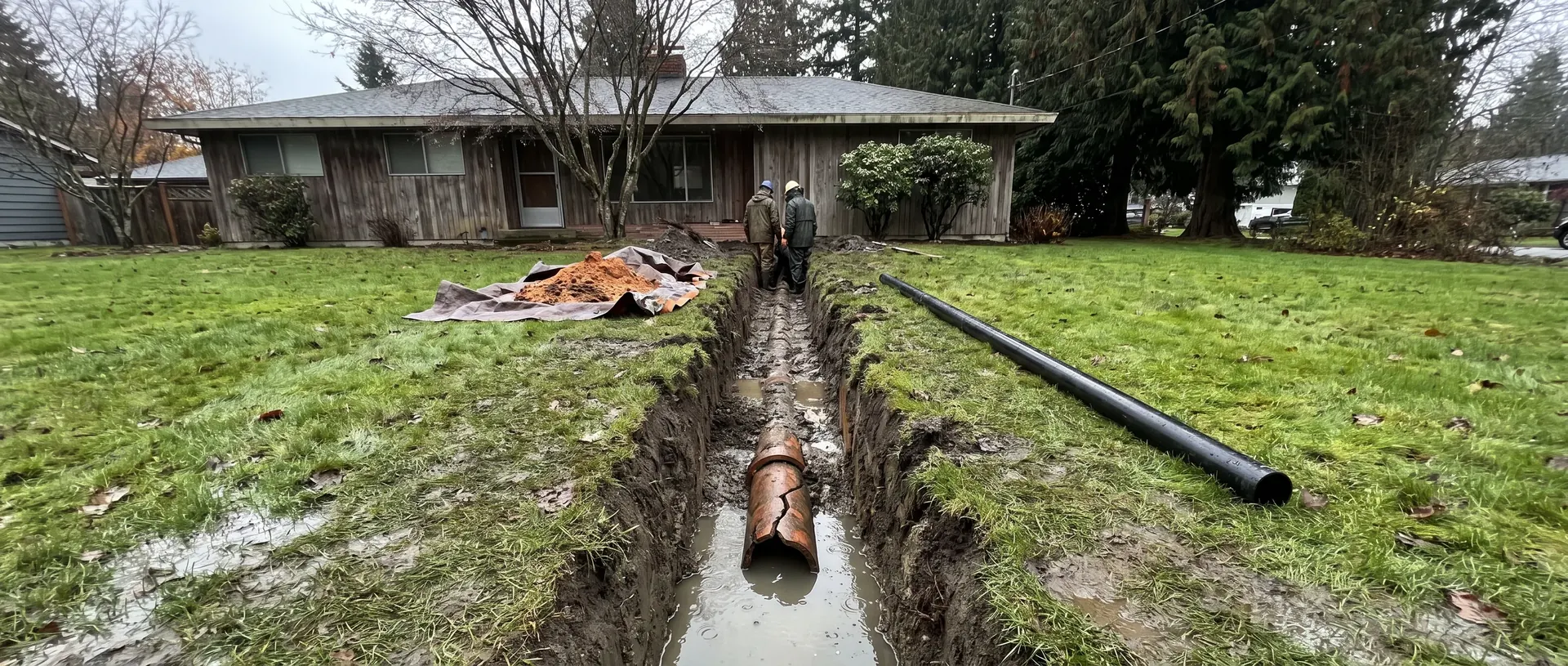
Most failures we find are local. One joint has offset where the ground moved. One section has sagged into a belly that holds water. Roots have opened a single clay joint under a maple. A length of Orangeburg has gone oval while the rest of the run is still round. Those are spot repairs, and a spot repair done in the correct location with the correct depth is a day rather than a week.
Full replacement is sometimes genuinely the answer. A run of Orangeburg that has deformed along its whole length is not going to be saved by fixing one part of it. Multiple failures spread over the same lateral usually means the material is at the end of its life. When that is what the footage shows, we will say so plainly, and you will be able to see why.
The difference between those two conversations is a camera run. That is why we never quote a repair without one.
What we find
What we repair
Offsets, cracks and collapses
Ground movement, settlement over a poorly compacted trench, or age. A section that has shifted or broken catches solids and will never stop doing it. Excavate, replace the section, backfill and restore.
Bellies and failed grade
A dip in the run that holds standing water and settles solids into it. Clearing a belly is temporary by definition, because the water comes straight back. Fixing it means re establishing fall over that section.
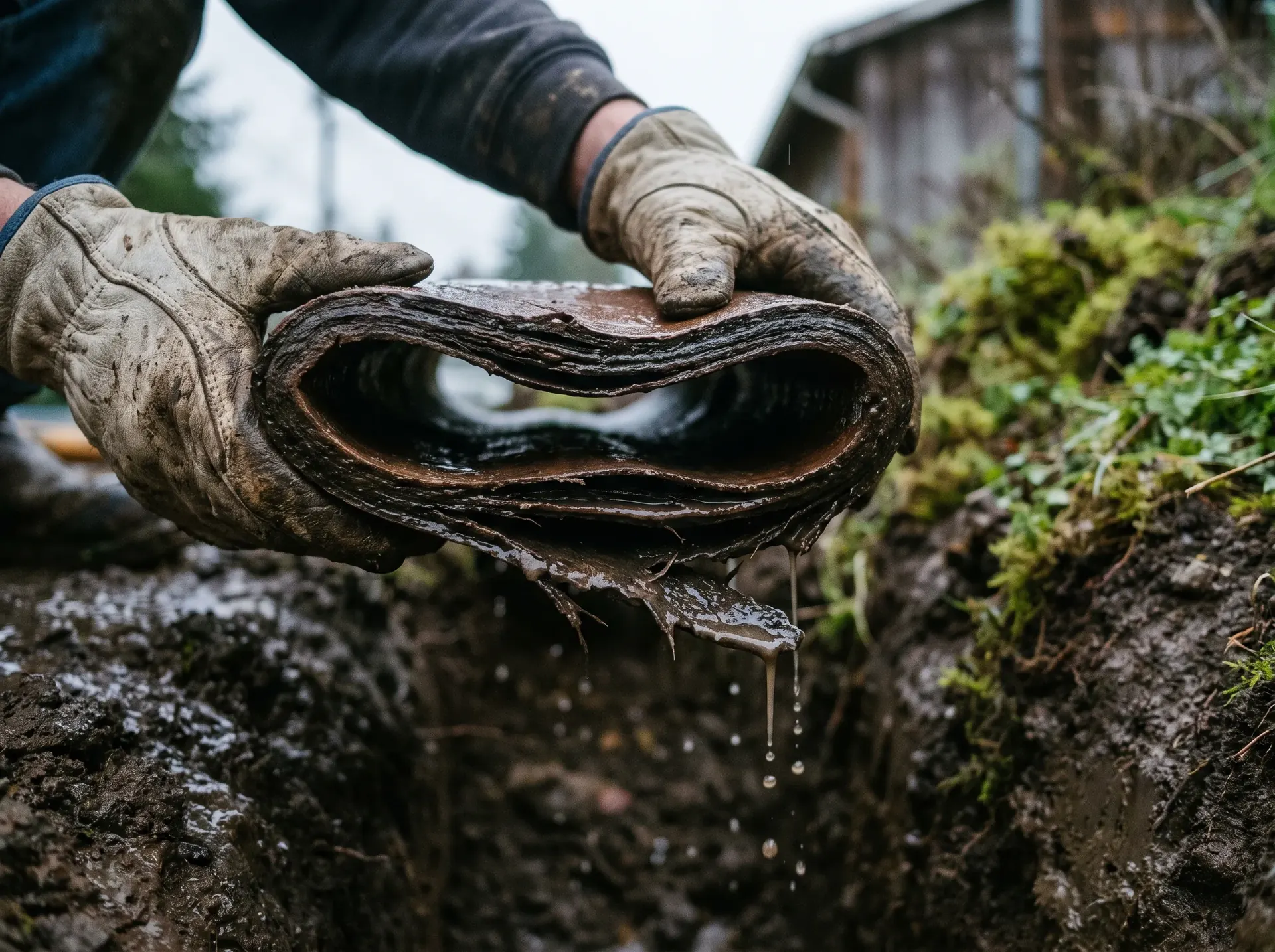
Failed Orangeburg conduit
Bituminous fibre pipe, common in houses built here between roughly 1945 and 1972. It fails by deforming out of round and delaminating rather than by cracking. Once it has gone oval it does not recover, and it will not survive jetting.
On the day
What a repair job includes
A camera run and a surface locate first, every time.
Depth, distance and position marked on the ground before anyone digs. This is what keeps a repair small.
A clear scope before work starts.
What is being replaced, how long the excavation is, what the restoration covers, and what would change the number.
The excavation, the replacement and proper backfill.
Compacted in lifts, not shovelled back loose to settle into a new belly over the following two winters.
A camera run afterwards.
So you can see the finished line, with the defect gone and the grade correct. You keep that footage as well.
Step by step
How we work
We look at the line properly.
Recorded camera run, the full length, so the decision is based on all of it rather than the first thing we find.
We locate and mark the defect.
Sonde trace for position and depth, marked on the surface, along with anything else that will be in the way.
We tell you what we would do and why.
Spot repair, section replacement, or full lateral. With the footage on screen while we say it.
We agree the scope and the restoration.
Including what the ground will look like afterwards. Lawn, driveway and a mature root plate are three different restoration problems.
We do the work.
Excavation, replacement, compacted backfill, and any cleanout installation that makes future access sane.
We film it again and hand it over.
The repaired section on camera, and a straight answer about the condition of the rest of the run.
Why us
Why call us for this
We do not quote a repair without footage
It is the only defensible way to price work that is underground. It also means you can check our recommendation against anyone else's.
We look for the smallest repair that actually works
Small does not mean cheap and temporary. It means correctly located. Most of the cost of a sewer repair is the digging, so digging once, in the right spot, is the whole game.
We will add a cleanout while we are in there
A lot of older houses here have no exterior cleanout at all. If we have the ground open, putting one in makes every future visit cheaper and less invasive.
We know what Orangeburg looks like on camera
It is the single most consequential thing to identify correctly in this county's post war housing stock, and it is easy to mistake for something less serious.
Reviews
What our customers say
We have not collected any reviews yet. When we do they will appear here in full, in the customer's own words.
Questions
Sewer line repair questions
How much does sewer line repair cost?
It depends almost entirely on how much digging is involved: the depth, the length, what is on top of it, and what has to be restored afterwards. A spot repair in a lawn and a full lateral replacement under a driveway are different orders of magnitude. We price it after the camera run, not before.
Do I need to replace the whole sewer line or just part of it?
That depends on whether the failures are local or spread through the run, and on what the pipe is made of. One offset joint in otherwise sound clay is a spot repair. Orangeburg that has deformed along its length is not. The footage answers this and you should insist on seeing it.
Does homeowners insurance cover sewer line repair?
Typically not for gradual failure, deterioration or root intrusion, which is what most of these are. Some policies offer a service line endorsement as an add on, and damage inside the house caused by a backup is sometimes treated differently from the pipe itself. Check your own policy wording, and do not assume either way.
What is Orangeburg pipe and why does it matter here?
It is bituminous impregnated wood fibre conduit, used widely from the mid 1940s into the early 1970s, which covers a large share of the housing built in this county. It fails by going oval and delaminating rather than cracking. If you have it, that is the finding that matters most, and it will not tolerate jetting.
Can a sewer line be repaired without digging up the yard?
Trenchless methods exist and they suit some situations, particularly long straight runs under hard surfaces. They are not a fit for a collapsed line, a severe belly, or pipe that has lost its structural shape. We will tell you honestly which category your line is in rather than sell you the method we prefer.
How long does a sewer line repair take?
A located spot repair in accessible ground is usually a day. Depth, groundwater, hard surfaces above the line and restoration requirements all extend it. On the wet ground around Sumas and Birch Bay the water table itself is often the thing that sets the pace.
Where we do this work
Anywhere else in Whatcom County, call and ask.
Tell us the symptoms