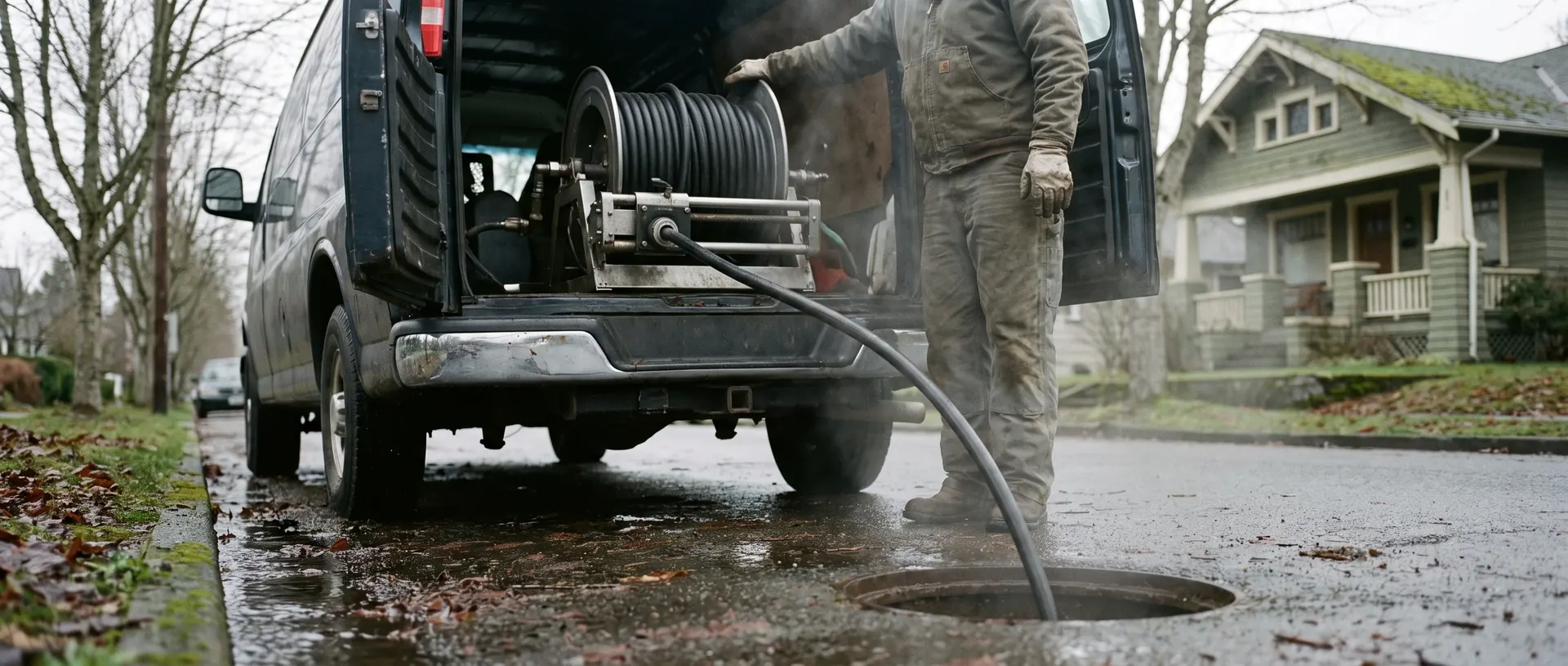
Hydro Jetting
When the pipe itself is the blockage
Picture a two inch kitchen line that has been carrying warm fat for twenty years. Nothing is stuck in it. There is no object to retrieve. The pipe has simply been getting narrower from the wall inwards, a layer at a time, until what is left in the middle is about the width of a pencil.
Run a cable through that and you get flow back, because you have made the hole bigger. You have not removed anything. Everything that made the pipe narrow is still there, still warm, still catching the next thing that goes down.
Hydro jetting is water at high pressure through a nozzle that fires backwards. The jets pull the hose up the line, scour the wall as they go, and flush what they cut back toward the access point. Done properly, the line ends up at the diameter it was laid at, and there is nothing left on the wall for the next thing to stick to.
That is the whole argument for it. It is also why it is not the answer to every blockage. A facecloth in a toilet needs retrieving, not scouring.
What we find
What jetting is actually for
Grease and fat in kitchen lines
The classic case, in houses and in small commercial kitchens. Fat goes down warm, cools on the wall, and never leaves. Cabling buys months. Jetting takes the wall back and resets the clock properly.
Scale, sludge and mineral build up
Older cast iron corrodes inward into a rough, restrictive surface that catches everything passing through it. Long, flat runs collect sludge for the same reason. Both respond to water in a way they do not respond to steel.
Fine root hair through joints
A cutting head takes out the thick roots. The fine hair left in the joint keeps catching solids and grows back fastest. Jetting after cutting clears the hair and leaves a clean wall, which is what makes the interval between visits longer.
On the day
What a jetting visit includes
A camera run first, on anything old.
Pressure into a line that is already cracked, offset or made of failing Orangeburg is a way of turning a blockage into an excavation. We look before we jet.
Pressure and nozzle matched to the pipe.
Different material, different diameter, different problem, different setup. A grease line and a root line are not the same job with the same head.
The full run, not the first restriction.
The hose goes to the transition or the main, cutting on the way out as well as on the way in.
A camera run afterwards.
So you can see the wall you paid for. This is the part that separates jetting from a very expensive way of pushing water down a pipe.
Step by step
How we work
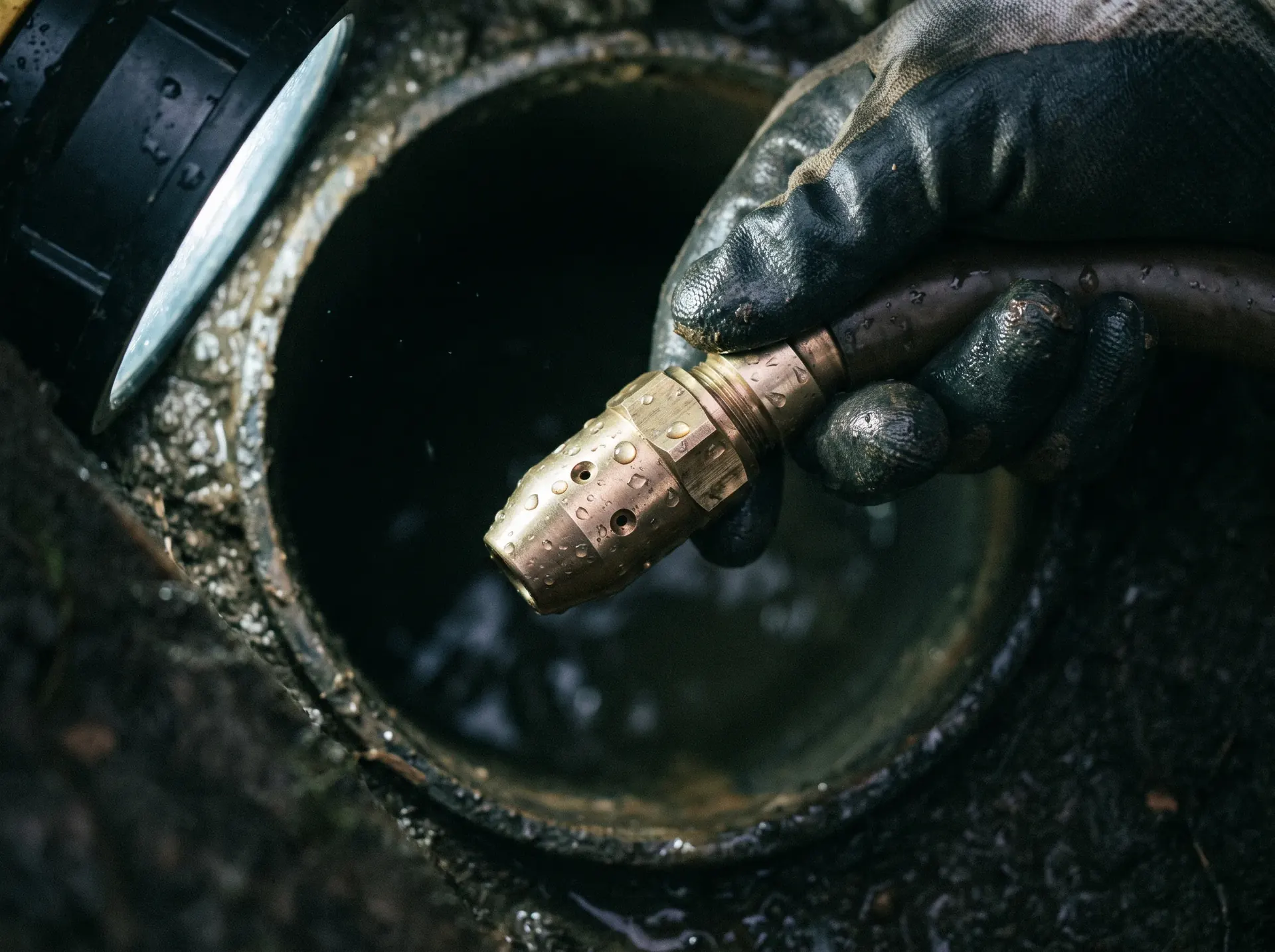
We establish whether jetting is right.
Grease, scale, sludge and root hair, yes. An object in the line, no. If a cable is the correct tool we will say so, and you will pay for the cable.
We camera the line first.
Material, condition, joints, bellies, and any spot that will not tolerate pressure. On anything pre 1975 this step is not optional.
We set up at proper access.
An exterior cleanout wherever possible. Jetting through a fixture is a last resort and we will tell you if that is what it takes.
We jet the full run.
Nozzle and pressure chosen for the pipe, the hose worked out to the transition, cutting on the way back as well.
We camera it again.
You see the wall afterwards. If the line still has a defect that jetting cannot fix, this is where it becomes visible instead of theoretical.
We tell you what changes it.
A kitchen line that grew a grease layer once will grow another one. What matters is what goes down it, and we will be specific about that rather than vague.
Why us
Why call us for this
We camera before we put pressure in a line
This is the single most important thing about jetting an older house, and it is the step most often skipped. Whatcom County has a lot of old pipe in the ground.
We will talk you out of it when it is wrong
Jetting a line that needs a cable is an expensive way to solve a cheap problem. If that is the situation, we will say so on the phone.
You see the before and the after
Two camera runs, and the footage is yours. There is no other way to prove the pipe wall is actually clean.
We do drains all week
Not water heaters, not fixtures, not remodels. The jetter is not a machine we get out occasionally.
Reviews
What our customers say
We have not collected any reviews yet. When we do they will appear here in full, in the customer's own words.
Questions
Hydro jetting questions
Is hydro jetting worth the cost?
For grease, scale, sludge and root hair, yes, because it removes the problem instead of making a channel through it, and you stop buying the same visit twice a year. For a single object stuck in a fixture line, no. The honest test is whether the same drain has blocked more than once in the same place.
How much does it cost to hydrojet your sewer line?
More than cabling, and it depends on the length of the run, the access, and whether a camera inspection is included. Over any period longer than a season it is usually cheaper than cabling the same line repeatedly. You get the number before we start.
How often should I hydrojet my sewer line?
Most houses never need it on a schedule. A kitchen line in a house that cooks a lot, or a main with roots at a joint, may want an interval. After a camera run we will tell you what your line actually needs rather than quoting a general rule, and if the answer is that it does not need one, that is what you get.
How long does it take to hydrojet a sewer line?
A residential run with good access is usually a couple of hours, including the camera work before and after. Longer where there is no exterior cleanout, where the run is unusually long, or where roots need cutting before the jetter goes in.
Can I do hydro jetting myself?
Rental and consumer jetters exist and they are a genuinely bad idea in a sewer line. The pressure is high enough to injure you and to finish off pipe that is already failing, you cannot see what you are working in, and the hose is very easy to lose in a line. The part professionals are paid for is the camera run that says whether the pipe can take it.
What is the difference between hydro jetting and snaking?
A cable is steel, and it cuts or pulls an obstruction out of the way. Water at pressure scours the whole inside surface of the pipe. One clears a blockage, the other restores the diameter. Our full comparison goes through when each one is right.
Where we do this work
Anywhere else in Whatcom County, call and ask.
Tell us the symptoms