Nobody can tell you what your drain will cost over the phone without asking questions, and anyone who does is either quoting the cheapest possible version to get in the door or the most expensive one to protect themselves. Both of those get corrected later, in your kitchen.
What we can do is tell you exactly which factors move the number, so that when you get a price you can tell whether it makes sense. There are five of them, and they matter in roughly this order.
1. Which line is blocked
This is the biggest single factor and it costs nothing to work out before you call.
If one fixture is slow and everything else in the house is fine, the blockage is in that fixture’s own branch line. Short run, small diameter, usually reachable in minutes. That is the cheap version.
If more than one fixture is affected, or if using one fixture makes another gurgle or rise, the main line is restricted. Longer run, larger pipe, heavier equipment, and usually a camera afterwards. That is a different job at a different price, and it should be.
Run water at every fixture in the house before you call. Two minutes of checking can halve the conversation.
2. How you get into the pipe
An accessible exterior cleanout is the difference between a straightforward job and an awkward one. With one, we open a cap and go to work. Without one, we are reaching the line through a fixture or pulling a toilet, which takes longer and needs the room protected.
A lot of older housing in Bellingham and the small towns has no exterior cleanout at all, because nobody installed one when the house was built and nobody has needed to add one since. If you have never seen a capped pipe standing a few inches out of the ground near your foundation, there is a reasonable chance there is not one.
That is worth mentioning when you call, because it changes what the visit involves. It is also a good reason to have one installed while somebody has the ground open for another reason.
3. What is actually in the line
An object is quick. A soft blockage of hair and soap is quick. Both are a case of choosing the right head and pulling the material out.
Roots are slower, because cutting them takes passes and the fine hair left behind is what brings them back. Hardened grease is slower still, because there is no single blockage to remove: the pipe wall itself has closed in, and cabling only makes a channel through it. That is the case where jetting is genuinely the cheaper answer over any timescale longer than a season.
4. Whether the line needs filming
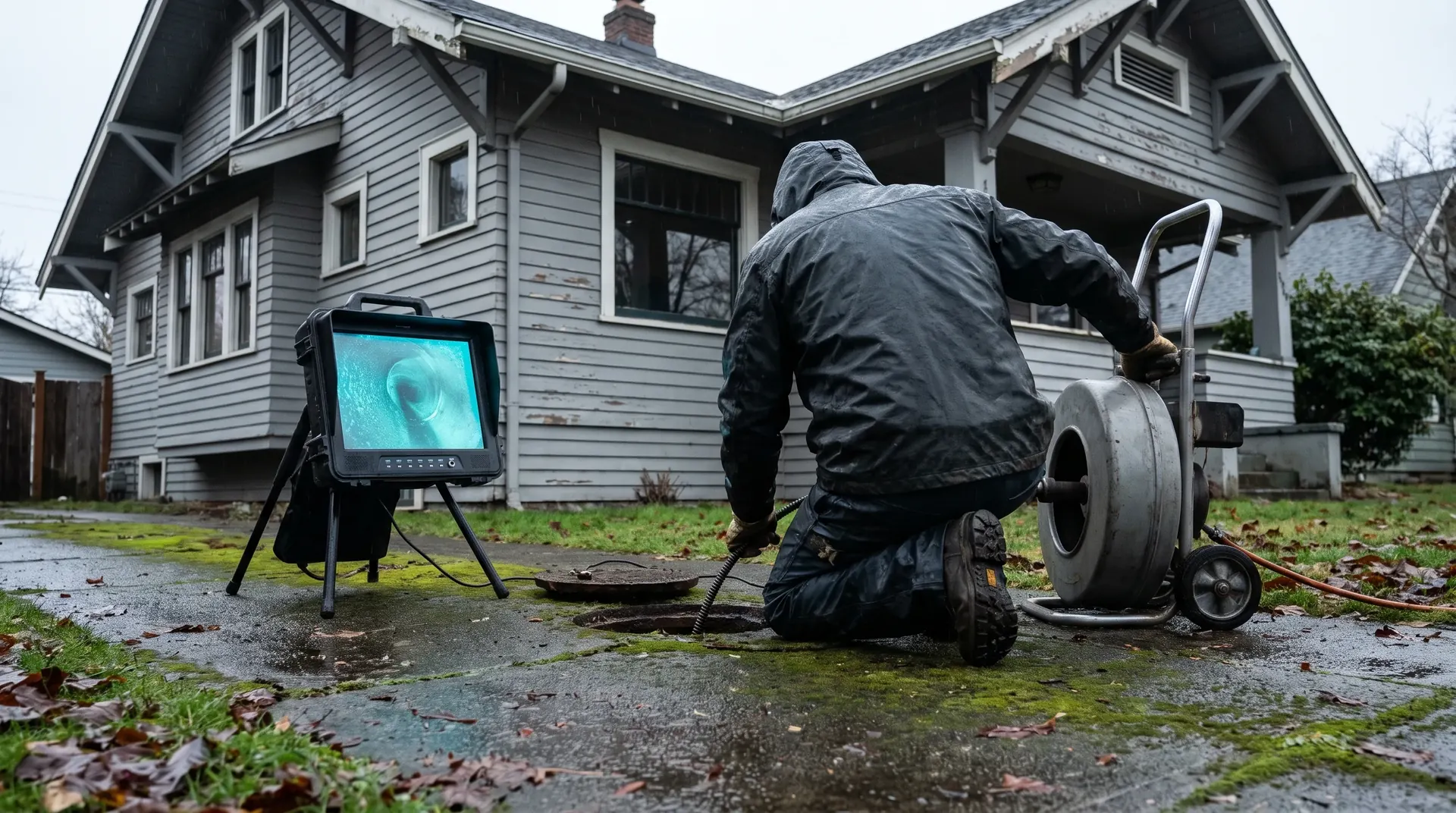
On main line work we treat a camera run as standard rather than an extra, and it does add to the visit. It is worth understanding what you are buying.
Clearing a main line without looking at it tells you nothing about why it blocked. If the cause was a one off, you have paid for a clear and that is the end of it. If the cause was roots at an offset joint, or a belly holding water, the line will do exactly the same thing again on its own schedule, and you will pay for the same visit repeatedly without ever finding out why.
The camera turns a recurring cost into a one time decision. On a fixture line it is usually unnecessary. On a main line it almost always pays for itself.
5. When you call
Out of hours and emergency work costs more than a scheduled visit, everywhere and for everyone. That is real and it is not a markup on panic.
What it means practically is that a slow drain is much cheaper on Tuesday morning than the same drain fully blocked on Sunday night. Drains that are getting slower rarely get better on their own, and the gap between those two prices is usually larger than people expect.
Things that should not move the number
A few things get treated as price factors and should not be.
How worried you sound. How large the house is. Whether the visit is on a Friday. Whether somebody else has already tried and failed, which is common and is not your fault.
And one more: a quote for a repair should never be based on a description of what somebody thinks is down there. If a company recommends replacing a sewer line without putting a camera in it, the honest response is to ask for the footage. Underground work is the easiest work in the trade to overstate, and the recording is the only thing that keeps everyone honest.
When to stop waiting
-
Two or more fixtures are affected, or one reacts when you use another
-
Anything is coming up at a floor drain, a shower or a ground floor toilet
-
The same drain has blocked more than twice in a year
-
A drain has been getting gradually slower over months rather than suddenly stopping
-
You have been quoted a sewer replacement without being shown the line
The first two are urgent. The middle two are cheaper to deal with now than later. The last one is worth a second opinion.